What is Google Merchant Center and why it matters for online stores
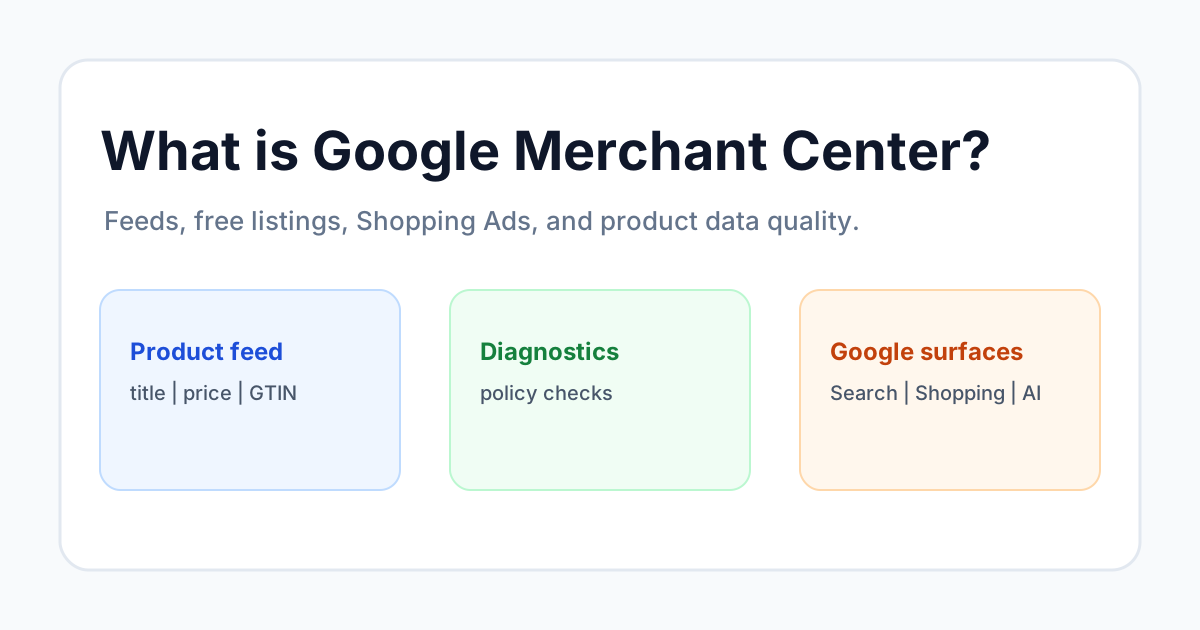
If you run an online store and want products to appear in Google Search, Google Shopping, YouTube, Google Images, Maps, or Performance Max campaigns, Google needs a structured, controlled source of product truth.
That source is Google Merchant Center.
In short, Merchant Center is the free platform where merchants send product data: title, description, price, image, availability, brand, GTIN, category, shipping, returns, and other attributes. Google uses that data for free listings, Shopping Ads, Performance Max, and increasingly for AI-assisted shopping experiences.
Official references:
- Get started with Merchant Center
- Google Merchant Center overview
- Product data specification
- Free listings for products
Merchant Center in plain language
Your website is where customers buy. Merchant Center is where Google receives structured data about those products.
For a phone, Merchant Center might receive:
- product name and landing page URL
- main image
- price and availability
- color and storage variant
- brand and GTIN
- shipping and return policy
- Google product category
Without Merchant Center, Google may only partially understand a product from the page. With a feed, Google gets a version of the catalog that is structured, controlled, and refreshable.
Why Merchant Center exists
Shoppers search in very specific ways:
- “Samsung Galaxy S25 128GB navy”
- “5G phone with eSIM”
- “USB-C charger 25W”
- “phone in stock today”
Merchant Center helps Google match the right offer to the query, show the right price and stock status, avoid disapprovals, connect the catalog to Google Ads, and extend products into free listings and AI surfaces.
What a product feed is
A product feed is the file or data stream that sends your catalog to Merchant Center. It can be:
- TSV, CSV, or XML
- a Google Sheet
- an ecommerce integration (Shopify, WooCommerce, PrestaShop)
- Merchant API
- automatic extraction from the site when enabled
Each row is a product. Each column is an attribute.
Example:
id	title	link	price	availability	image_link	brand
65143	Samsung Galaxy S25 5G 128GB Navy	https://www.example.com/product/samsung-s25	2999.00 RON	in_stock	https://www.example.com/img/s25.jpg	Samsung
In production, feeds often have dozens of columns and strict formatting rules.
Important attributes
| Attribute | Meaning |
|---|---|
id | Unique product identifier in the feed |
title | Product title |
description | Product description |
link | Product page URL |
image_link | Main image |
price | Price |
availability | Stock status |
brand | Brand |
gtin | Global trade item number |
google_product_category | Google category |
item_group_id | Variant grouping |
shipping | Shipping rules |
return_policy_label | Return policy where applicable |
For large catalogs, feed quality directly affects Shopping Ads, Performance Max, and free listing performance.
Merchant Center vs Google Ads
| Platform | Role |
|---|---|
| Merchant Center | Tells Google what products exist, what they cost, and where they live |
| Google Ads | Decides how products are promoted, with what budget and audience |
Shopping Ads and Performance Max with products depend on Merchant Center data. If the feed is wrong, campaigns underperform even when bidding strategy is sound.
Free listings vs paid ads
Merchant Center is not only for paid media. Eligible products can also appear in free listings across Search, Images, Lens, YouTube, Gemini, the Shopping tab, and Business Profile modules.
| Surface | Cost | Control |
|---|---|---|
| Free listings | Free | Less control over position and volume |
| Shopping Ads / Performance Max | Paid | Budget, bidding, and campaign control |
In both cases, feed quality matters.
How products get into Merchant Center
1. Manual upload or Google Sheet
Good for small catalogs or pilots. Fast to start, but hard to maintain at scale.
2. Programmatic file generation
Best for medium and large catalogs. Requires a technical pipeline and monitoring.
3. Ecommerce platform integration
Easier to launch, but advanced attributes often need customization.
4. Merchant API
Best for large or highly dynamic catalogs that need frequent updates from internal systems.
What happens after upload
Google validates the feed, checks required attributes, compares feed data with the product page, reviews policy compliance, then approves, limits, or disapproves products.
Common issues:
- feed price does not match the site
- availability is wrong
- image is too small or has a watermark
- GTIN is missing
- title is too generic
- shipping or returns are misconfigured
Why feed quality matters
A strong feed improves relevance, reduces disapprovals, increases click-through, supports cleaner diagnostics, and prepares the catalog for AI shopping.
A weak feed leads to missing products, lost traffic, poor campaign performance, and recurring Merchant Center errors.
Merchant Center and SEO
Merchant Center is usually associated with ads, but it also matters for organic product visibility. For ecommerce, three sources of truth should align:
- the product page
- structured data / Schema.org
- the Merchant Center feed
If all three disagree on price or availability, Google may limit or reject the product.
Merchant Center and AI shopping
Users increasingly ask complex questions:
- “I want a phone with a good camera and battery under a budget.”
- “What accessory fits this phone?”
- “Does it include a charger?”
That is why Google is extending the feed with conversational attributes such as question_and_answer, related_product, variant_option, and item_group_title. They do not replace the classic feed—they extend it.
Who should own Merchant Center
| Team | Responsibility |
|---|---|
| Ecommerce | Catalog, prices, stock, product pages |
| Performance media | Shopping / Performance Max campaigns |
| SEO | Free listings and landing page consistency |
| Product data / PIM | Attributes, variants, GTIN, categories |
| IT / development | Feed, API, automation |
| Legal / compliance | Returns, claims, regulated information |
| Analytics | Performance, top products, errors |
Basic health checklist
- Stable unique
idvalues - Titles include brand, model, and key variants
- Feed price matches the site
- Availability is current
- Images are clear and policy-compliant
- GTIN is sent where available
- Variants are grouped with
item_group_id - Google categories are precise
- Shipping and returns are configured
- Diagnostics are monitored regularly
- Feed, site, and structured data are consistent
Conclusion
Google Merchant Center is the infrastructure that makes an ecommerce catalog usable across Google’s ecosystem. The real question is not “do we have a feed?” but whether that feed is complete, accurate, fast to update, aligned with the site, and ready for AI shopping.