Conversational attributes in Google Merchant Center: a practical guide for ecommerce teams
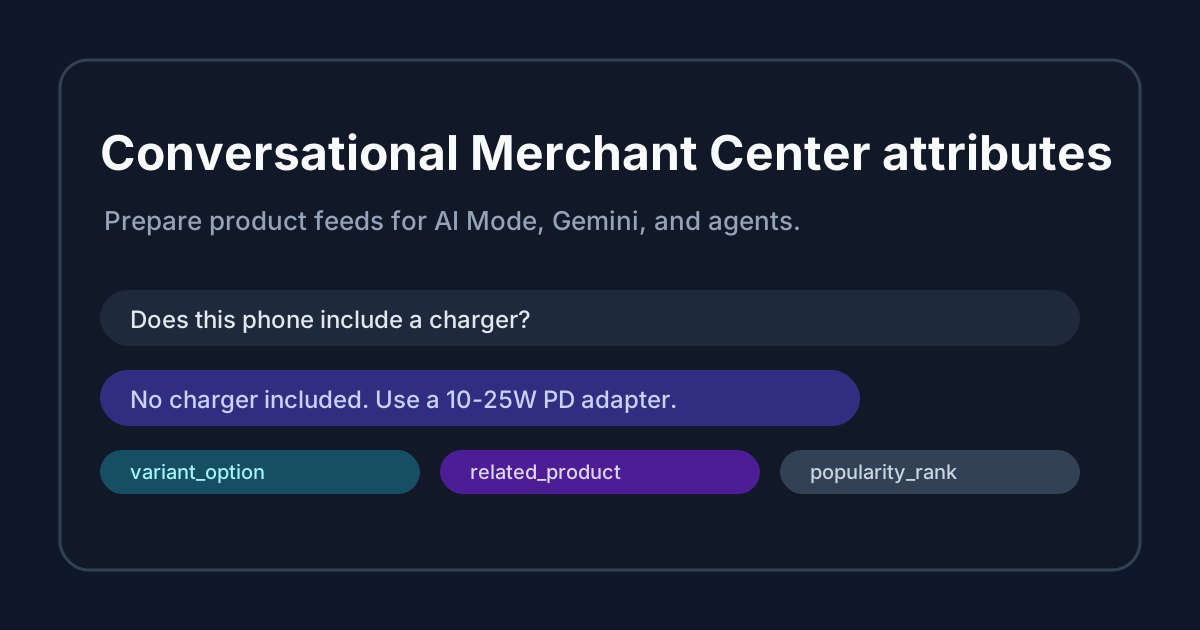
Search is no longer just a list of links. Shoppers ask detailed questions, compare variants, and want to know whether a phone includes a charger, what warranty applies, or which accessory fits.
For ecommerce teams, that changes how product feeds must be prepared.
Google introduced conversational attributes in Merchant Center: optional fields that help AI systems understand products, variants, relationships, and common customer questions. They do not replace the classic feed. They extend it.
What conversational attributes are
These fields are designed for experiences such as:
- AI Mode in Google Search
- Gemini
- future Business Agent experiences
According to Google, they are:
- optional
- additive
- non-disruptive to existing product approvals
- especially useful for detailed questions, not just keyword matching
The six main attributes are:
question_and_answerdocument_linkrelated_productitem_group_titlevariant_optionpopularity_rank
Question and answer
The most discussed attribute. It lets merchants send question–answer pairs about a product.
Example:
- Q: “Does the phone include a charger in the box?”
- A: “This model does not include a charger in the box.”
Limits:
- up to 30 Q&A pairs per product
- maximum 10,000 characters total
- no prices, promotions, or time-dependent data
Document link
Attach public PDFs such as manuals, spec sheets, or assembly instructions. Documents must be crawlable and distributable by the merchant.
Related product
Link a product to accessories, required parts, substitutes, or frequently bought together items.
Item group title
Provide a shared title for all variants of a product.
Example:
- variant title:
Samsung Galaxy S25 5G Dual SIM | 128GB | Navy - group title:
Samsung Galaxy S25 5G Dual SIM
Variant option
Describe variant dimensions explicitly.
Example: color:navy,storage:128GB
Popularity rank
A score from 0.0 to 100.0 indicating relative popularity inside the merchant catalog.
Why this matters now
Google is investing in agentic commerce:
- Universal Commerce Protocol (UCP)
- Business Agent
- richer Merchant Center data for conversational shopping
Google is optimizing for real questions, not just keyword + title + price. For retailers, the product feed is becoming a strategic asset—not only a technical requirement for Shopping.
How to send these attributes
Google recommends three paths:
- Supplemental feed — best for pilots
- Primary feed — possible, but riskier operationally
- Merchant API — best for automation at scale
Why supplemental feed is the best first step
- you do not touch the critical primary feed pipeline
- you can test on 20–100 SKUs
- you can stop or adjust quickly
- ownership can be split: primary feed = IT/ecommerce, conversational = SEO/content/product data
What belongs in conversational attributes
| Site content | Google attribute |
|---|---|
| color / storage | variant_option, item_group_title |
| “no charger in the box” | question_and_answer |
| recommended adapter | question_and_answer |
| warranty | question_and_answer |
| return policy | question_and_answer |
| frequently bought together | related_product |
| sales rank / top products | popularity_rank |
What does not belong in Q&A
Do not use conversational attributes for:
- vouchers
- subscription discounts
- promotional financing
- personalized logged-in prices
- limited-time campaigns
Wrong:
- “How much is it with voucher SUN80?”
- “Until when is the TBI campaign valid?”
Right:
- “Does the phone include a charger?”
- “What warranty does the product have?”
- “Can I return the product within 30 days?”
Example for a phone SKU
Product:
Samsung Galaxy S25 5G Dual SIM | 128GB | Navy
Recommended conversational data:
item_group_title
Samsung Galaxy S25 5G Dual SIM
variant_option
color:navy,storage:128GB
question_and_answer
- “Does the phone include a charger in the box?” → “This model does not include a charger in the box.”
- “What charging adapter is recommended?” → “Use a compatible Power Delivery adapter between 10 W and 25 W.”
- “What warranty does the product include?” → “The product includes a 24-month warranty when purchased from the online store.”
- “Can I return the product if I am not satisfied?” → “You can return the product within 30 days according to the store return policy.”
related_product
- compatible case
- recommended PD charger
- alternative model in the same range
popularity_rank
92.0
A practical 4-step pilot
Step 1: verify Merchant Center
Confirm whether your account already accepts the new fields in supplemental feed mapping.
Step 2: choose a small pilot
20 products is enough:
- 10 popular phones
- 5 accessories
- 5 products with multiple variants
Step 3: create a supplemental feed
Minimum columns:
iditem_group_titlevariant_optionquestion_and_answer
Step 4: monitor calmly
Check Diagnostics for errors. If the pilot is clean, expand category by category.
Common mistakes to avoid
- Copying the product description into Q&A
- Using Q&A for promotions or prices
- Mapping the wrong
id - Scraping frontend content instead of stable backend sources
- Linking unstable or non-crawlable PDFs
Expected benefits
Google does not promise a universal CTR lift yet, but the likely gains are:
- better answers in AI experiences
- stronger visibility for detailed questions
- differentiation versus competitors with minimal feeds
- readiness for Business Agent and agentic commerce
- cleaner relationships between products, variants, and accessories
Recommended priority
item_group_titlevariant_optionquestion_and_answerrelated_productpopularity_rankdocument_link
Conclusion
Conversational attributes are not a marketing gimmick. They are a natural extension of product data in a world where users want answers, not just links.
The advantage is not sending more text. It is sending more clarity.